
Plus500 is a well-established global fintech and online trading broker, founded in 2008. The company originated in Israel, but today Plus500 Ltd is headquartered in the United Kingdom and listed on the London Stock Exchange’s Main Market as a constituent of the FTSE 250 Index. Through its various regulated subsidiaries, Plus500 is authorised in multiple jurisdictions, including the UK (FCA), Cyprus (CySEC), Australia (ASIC), Singapore (MAS), South Africa (FSCA), the UAE (DFSA/SCA), Canada (CIRO), the Bahamas, and others.
Plus500 offers CFDs on a wide range of asset classes—including forex, shares, indices, commodities, ETFs, and options—through its proprietary trading platforms, which are available on web, desktop, and mobile. The platform is designed for simplicity and efficiency, offering real-time pricing, risk-management tools, advanced charting, alerts, and an intuitive interface. With +AI Bites, you can view concise AI-generated market snapshots directly inside the trading chart. Instead of jumping between news sites, sentiment tools, technical analysis platforms, and market summaries, +AI Bites brings key information together in one place.
For U.S. traders, Plus500 also provides futures and options on futures through its U.S.-based entity, offering access to popular U.S. futures markets without CFDs (as CFDs are not permitted for U.S. retail clients).
Plus500 also provides access to regulated prediction markets through its futures platform, allowing traders to participate in event-based contracts tied to real-world outcomes such as economic indicators, geopolitical developments, and financial events. This reflects a broader shift toward making prediction markets more accessible, transparent, and aligned with traditional trading infrastructure.
Trading conditions are generally competitive, featuring tight spreads, no separate commission charges (costs are included in the spread), fast order execution, and responsive customer support. Plus500 serves hundreds of thousands of active clients worldwide and continues to expand its regulatory footprint and product offering.
Markets
Plus500 has an impressive range of markets with more than 2,800 CFD instruments available across multiple asset classes, including forex, shares, indices, commodities, options and ETFs. I like the variety because it means you can access different global markets from one platform without needing to maintain several trading accounts.
The exact instruments and products available will depend on your location and the Plus500 entity that you open an account with. CFDs are not available to retail traders in the United States, for example. Instead, Plus500 provides U.S. clients with access to regulated futures markets through its dedicated futures platform. Prediction markets are also available in the US.
Whether you prefer trading currencies, following individual companies, speculating on major stock indices or looking for opportunities in commodities, there should be plenty of instruments to choose from. Plus500 also provides some less commonly offered products such as Options CFDs, while its U.S. futures offering has been expanded to include Single Stock Futures.
Forex CFDs
Forex is naturally one of the first markets that I look at when reviewing a broker, and Plus500 provides access to a good selection of major, minor and exotic currency pairs through CFDs.
You can trade popular currency pairs such as EUR/USD, GBP/USD and USD/JPY, along with numerous crosses and less commonly traded currencies. This makes the forex selection suitable for different trading styles, whether you prefer concentrating on the most liquid major currency pairs or looking for opportunities elsewhere.
Forex CFDs allow you to speculate on whether one currency will strengthen or weaken against another without actually exchanging the underlying currencies. You can open either buy or sell positions, which makes it possible to trade bullish and bearish market conditions.
Positions are traded using margin, so you do not need to provide the full value of your market exposure upfront. This leverage is one of the main attractions of forex CFD trading, but it is important to remember that it works in both directions. While leverage increases your market exposure, it can also magnify losses if the market moves against your position.
Forex markets can be influenced by interest rates, inflation, central bank decisions, employment figures, political developments and general economic sentiment. I therefore like that Plus500 combines its forex markets with tools such as an economic calendar, price alerts, charts and risk management orders. Having these features readily available can make it easier to monitor events that could affect the currencies you are trading.
Overall, I think the forex offering provides more than enough variety for most retail currency traders, especially if you want a straightforward platform where you can analyse and trade currencies without unnecessary complexity.
Share CFDs
Plus500 has an extensive selection of Share CFDs covering companies from major international stock markets. You can speculate on the price movements of well-known companies from markets such as the United States, United Kingdom and Europe without having to purchase the underlying shares.
Popular companies available through Plus500 include major technology and growth stocks such as NVIDIA, Tesla, Microsoft and other internationally recognised businesses. The exact selection can change as new instruments are added and market availability develops.
When trading Share CFDs, you do not become a shareholder in the company. Instead, you are entering into a CFD whose value is based on movements in the underlying share price. This means you can potentially take advantage of both directions by buying when you think a stock will rise or selling when you think it will fall.
I find this particularly useful for shorter-term traders who are more interested in price movements than actually owning shares as a long-term investment. It also means that you can trade companies from several markets without needing separate traditional stockbroking accounts for each exchange.
Share CFDs are leveraged, so only a percentage of the total position value is required as margin. This can make them capital efficient, but leverage also increases risk and can magnify losses.
Individual stocks can be especially sensitive to earnings reports, company announcements, product launches, changes in management, mergers and acquisitions, analyst expectations and wider economic conditions. Plus500 provides charts, alerts and risk management tools that can be useful when monitoring these events and managing open positions.
Overall, there is a very good selection of Share CFDs available, making Plus500 worth considering if individual stocks form an important part of your trading strategy.
Index CFDs
If you would rather trade the direction of a broader stock market instead of trying to select individual companies, Plus500 provides a good range of Index CFDs covering many of the world’s most closely followed markets.
An index represents a group of stocks, so trading an Index CFD allows you to speculate on the overall performance of that group through a single instrument. This can be useful if your market view is based on the wider economy or a particular country’s stock market rather than the prospects of one company.
For example, traders may have a bullish or bearish view on the U.S. stock market as a whole rather than wanting to decide whether an individual technology, banking or consumer stock will outperform. An index can provide a more convenient way to express that view.
Plus500 provides access to major indices covering the United States, Europe, Asia and other regions. You can take both long and short positions, which makes Index CFDs suitable for trading rising or declining markets.
Stock indices can react strongly to central bank decisions, inflation figures, employment reports, economic growth expectations, geopolitical developments and major corporate earnings. This can create plenty of trading opportunities, although volatility can also increase quickly around important events.
I personally like indices because they provide exposure to multiple companies within one market and can be useful for traders who prefer analysing broader economic and market trends rather than individual businesses.
As with the broker’s other CFD markets, Index CFDs use leverage. Traders should therefore understand their margin requirements and use sensible position sizing and risk management.
Commodity CFDs
Plus500 also has a good range of Commodity CFDs covering energy products, precious metals and agricultural markets. Popular instruments include Gold, Silver, Oil and Natural Gas, along with other commodities.
Commodity trading can provide some useful diversification if you do not want to concentrate entirely on currencies and stock markets. These markets can behave quite differently depending on the economic environment, which can provide alternative opportunities when other asset classes are relatively quiet.
Gold is one of the most popular commodity markets and is closely monitored by traders around the world. Its price can respond to interest rate expectations, inflation, movements in the U.S. dollar, geopolitical uncertainty and general investor sentiment.
Oil and Natural Gas can be particularly volatile because they are influenced by global supply and demand, production decisions, geopolitical events, inventories and economic activity. Agricultural markets have their own drivers, including weather conditions, harvest expectations and changes in global supply.
Trading commodities through CFDs means you can speculate on their price movements without purchasing or storing the physical asset. You are therefore not going to have barrels of oil or bars of gold delivered to your house. You simply trade the price movement through the Plus500 platform.
You can open long positions if you believe the commodity will increase in value or short positions if you expect its price to decline.
Some Commodity CFDs reference futures markets, so it is worth checking the individual instrument details and understanding how expiry and rollover mechanisms may affect a position.
I think Plus500 has enough commodity markets to satisfy most retail traders who want to diversify beyond forex and stocks.
Options CFDs
One area where Plus500 stands out from many of the CFD brokers that I have reviewed is its selection of Options CFDs.
It is important to understand that these are not the same as purchasing traditional exchange-traded options. Plus500’s Options CFDs provide exposure to changes in the price of an option without giving you ownership of the underlying option contract or asset.
The broker offers CFDs based on both Call and Put options, with underlying instruments that can include stocks, indices and commodities. Traders can buy or sell supported Call and Put Options CFDs depending on their market expectations.
Options can be more complicated to understand than simply buying or selling a standard CFD because their prices are affected by several factors. These can include the current price of the underlying market, strike price, volatility, intrinsic value and the amount of time remaining until expiry.
Unlike many conventional CFDs that can remain open provided the instrument continues to trade, Options CFDs have expiry dates. This is something that you will need to take into consideration when planning a trade.
Options prices can sometimes experience large percentage movements compared with the underlying market, which can create opportunities but also means that risk can increase significantly. Add leverage into the equation and I would say these instruments are better suited to traders who already understand how options work.
That being said, I think it is good to see Plus500 offering something different from the standard forex, share, index and commodity CFD selection found at most brokers. Experienced traders may appreciate having Options CFDs available within the same platform.
ETF CFDs
Plus500 also provides a selection of ETF CFDs for traders who want exposure to a collection of securities, sectors or markets through a single instrument.
An Exchange Traded Fund can track anything from a stock market index or industry sector to commodities and other market themes. This makes ETFs a convenient way of gaining broader exposure without having to individually trade every asset represented by the fund.
When using Plus500, you are trading CFDs based on ETFs rather than purchasing units in the actual fund. You therefore do not own the ETF. Instead, you speculate on whether its market price will rise or fall.
One reason ETF CFDs can be attractive is the variety of exposure they can provide. Rather than choosing one technology company, for example, you could use an appropriate ETF to gain exposure to a collection of companies within the technology sector. Other ETFs can provide exposure to financial companies, commodities, indices and other themes.
Plus500 allows supported ETF CFDs to be traded using leverage and you can open either buy or sell positions. This provides flexibility, although leverage once again means that losses can be magnified as well as any potential gains.
I think ETF CFDs are a useful addition to the Plus500 market range because they sit somewhere between trading an individual asset and trading an entire broad market. They can be particularly useful for traders who have a view on a particular sector or investment theme rather than one specific company.
Single Stock Futures
Plus500 has expanded its U.S. futures offering with Single Stock Futures (SSFs), providing another interesting way for eligible U.S. traders to gain exposure to individual companies.
A Single Stock Future is a futures contract whose value tracks an individual company’s stock. Plus500 provides Single Stock Futures on major companies including the likes of Apple, Microsoft and Amazon.
They should not be confused with the Share CFDs available through Plus500’s other regulated entities. CFDs are not offered to U.S. retail clients, whereas Single Stock Futures are regulated futures products available through Plus500’s U.S. operation.
One of the main advantages of Single Stock Futures is that you can speculate on both rising and falling prices. You can take a long position if you think the underlying stock will increase or a short position if you expect it to decline.
You do not actually own the shares when trading a Single Stock Future. The contracts are financially settled, which means there is no physical delivery of company shares when the contract expires.
Single Stock Futures are also traded using margin. Rather than paying the full value of the shares represented by the contract, you deposit a proportion of the contract value as margin. This can provide significantly greater market exposure for the capital committed to the trade, although the resulting leverage can also increase losses.
Another feature that I like is the extended trading availability. Plus500 states that its Single Stock Futures can be traded up to 23 hours per day, five days a week. This can be useful for responding to earnings releases, breaking company news and other events that take place outside regular U.S. stock market hours.
There are also different contract sizes available. In addition to larger contracts, Plus500 offers Micro contracts, which can be useful for traders who want to start with smaller position sizes or have more control over their overall exposure.
Single Stock Futures differ from stock options in several important ways. Their pricing does not involve option Greeks such as Delta and Theta, and futures do not experience time decay in the same manner as options. This can make the directional exposure somewhat easier to understand for traders who are already familiar with conventional futures.
However, this does not mean that Single Stock Futures are simple or low-risk products. They still involve leverage, margin requirements, contract specifications and expiry dates that traders need to understand before opening a position.
I think Single Stock Futures are a welcome addition to Plus500’s U.S. product range. They combine exposure to individual stocks with many of the characteristics of futures trading, while the availability of Micro contracts and extended trading hours can provide additional flexibility. They are likely to appeal most to active U.S. traders who want to speculate on individual company price movements without purchasing the underlying shares.
Prediction Markets
Plus500 has also added Prediction Markets to its U.S. trading platform, giving eligible traders another way to speculate on the outcome of real-world events.
Prediction Markets work quite differently from the forex, stock and commodity markets that most traders will be familiar with. Rather than trying to predict whether the price of an asset will rise or fall, you are trading on whether a particular event will or will not happen.
Each event contract is based on a simple Yes or No question with an outcome that can be verified using reliable data. If you believe the event will happen, you can take a Yes position. If you think it will not happen, you can instead take a No position.
I think the concept is relatively straightforward compared to some more complicated derivatives. Prediction Market contracts are quoted in cents, with the price representing the market’s approximate assessment of the probability of an event taking place. For example, a contract trading around 47 cents would indicate that the market is pricing in roughly a 47% probability of that outcome.
When the event is resolved, a winning contract settles at $1 while a losing contract settles at $0. Your potential risk and return can therefore be easier to understand before entering a position than with some leveraged products whose losses can continue to increase as the underlying market moves.
There are still trading costs to consider. Plus500 currently charges a small commission per Prediction Market contract, while additional exchange fees can also apply. I would always check the latest charges directly on the platform before placing a trade as fees can change.
One thing I like about Prediction Markets is that they provide exposure to an entirely different type of trading opportunity. Instead of analysing charts for currencies, stocks or commodities, you can form a view on specific real-world events and trade according to whether you expect a particular outcome to occur.
However, I would not mistake the simple Yes or No format for guaranteed or easy trading. Market expectations can change rapidly as new information becomes available, and taking the wrong side of an event can result in losing the amount committed to the contract.
Plus500’s Prediction Market event contracts are offered through its U.S. operation on regulated exchanges and are subject to oversight from the Commodity Futures Trading Commission (CFTC). This is therefore a product aimed specifically at eligible U.S. traders rather than something that should be confused with the CFD products available through Plus500’s international entities.
Overall Product Range
Overall, I am impressed with the variety of markets available through Plus500. The CFD platform covers all of the main asset classes that I would expect from a major online broker, including forex, shares, indices, commodities, options and ETFs.
The inclusion of Options CFDs gives traders access to something that is not available with every CFD broker, while the expansion of the U.S. futures platform into Single Stock Futures provides another way for U.S. traders to access individual company price movements.
Having so many different markets available from the same trading environment can be convenient if you like to monitor multiple asset classes and move between markets depending on where you see opportunities.
Just keep in mind that availability varies according to your country and the Plus500 entity that provides your account. CFDs and futures are also leveraged products that involve a significant risk of loss, so it is important to understand how each instrument works before trading with real funds.
Platforms
The broker provides its clients with the proprietary Plus500 Trading Platform, available across desktop (Windows), web (browser-based) and mobile apps (iOS and Android). The platform features a user-friendly interface and a comprehensive toolset including real-time quotes, a built-in economic calendar, charting tools and alerts. Clients can trade across more than 2,800 CFD instruments across multiple asset classes — and in certain jurisdictions (notably the U.S.), futures trading is also offered.
You can search for instruments by name, load interactive charts, open buy or sell positions with live pricing, and use supported order types such as market orders, limit orders, stop loss, trailing stop and guaranteed stop (depending on region). The platform allows alerting via email, SMS or push notification for price movements or sentiment shifts, making it easier to stay engaged without staring at charts all day. The mobile apps mirror much of the functionality of the web version, making it convenient for traders on the go.
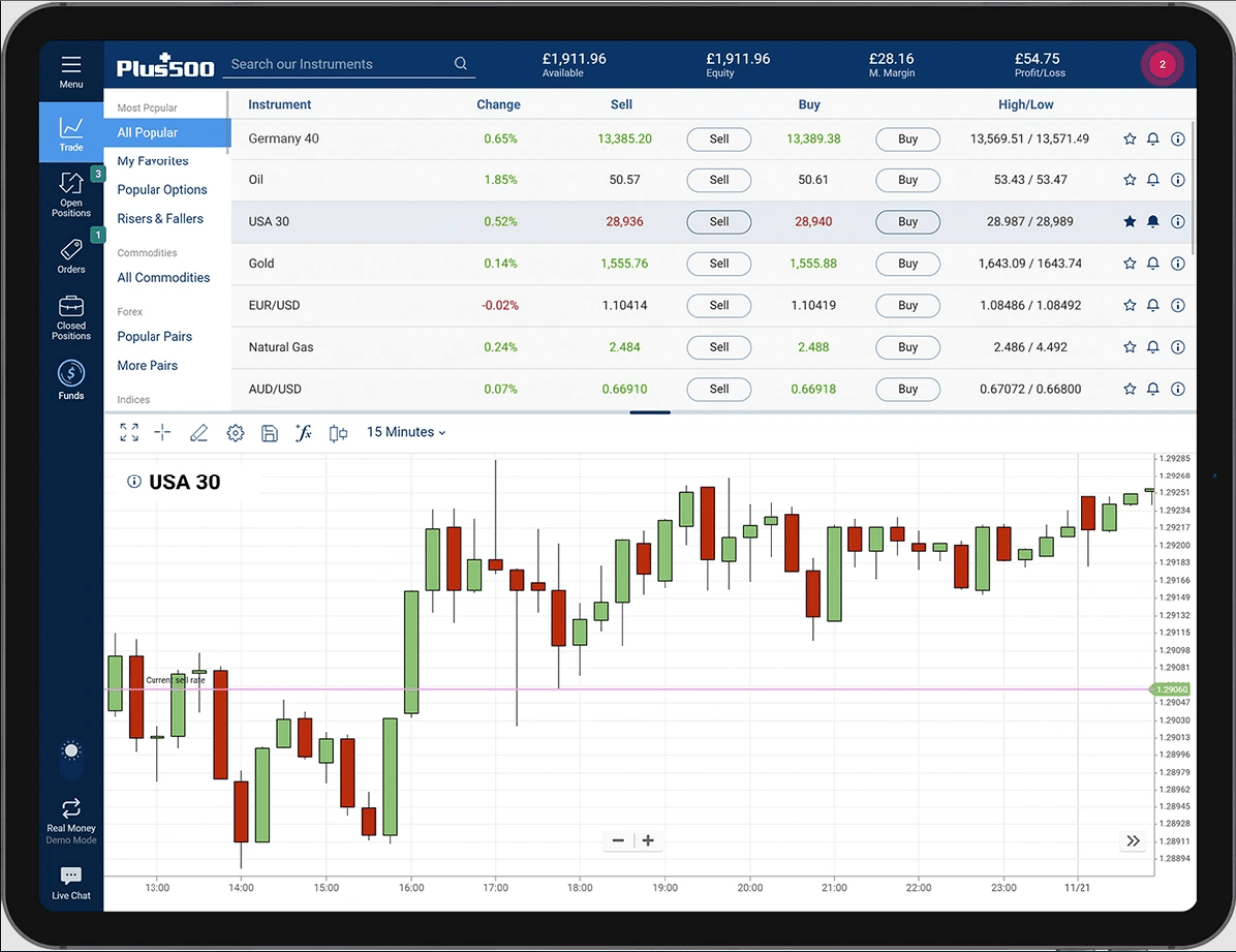
The Plus500 platform offers a solid range of charting tools suitable for both new and experienced traders. Charts can be viewed across multiple timeframes — from tick-level data up to weekly — and displayed in various formats, including candlesticks, bars and line charts. The platform includes many widely used technical indicators such as Moving Averages, Bollinger Bands, MACD and RSI, along with drawing tools for marking support and resistance levels, trendlines and Fibonacci retracements. Chart templates can also be saved for easy reuse.
A built-in economic calendar provides upcoming market events along with previous, forecast and actual data, which can be filtered by date or impact level. This is a useful tool for traders who incorporate fundamental analysis into their strategy.
Platform security includes optional two-step authentication, and users can also log in through Google or Facebook accounts for added convenience. While some brokers rely on third-party software such as MetaTrader, Plus500’s proprietary platform is modern, streamlined and designed to provide all essential trading functionality from a single interface. The platform is available in multiple languages and accessible on desktop, web and mobile devices.
Tools
Alerts
You can get email, SMS, and push notifications in real time. Setting up notifications is free, and available on all devices. Create alerts by clicking the alert icon on the main trading screen and view, amend, and delete alerts by selecting the “Alerts” tab in the programme menu.
Price Alerts: React to price movements as they occur. Set up price alerts to get notified when an instrument hits a certain Buy or Sell price.
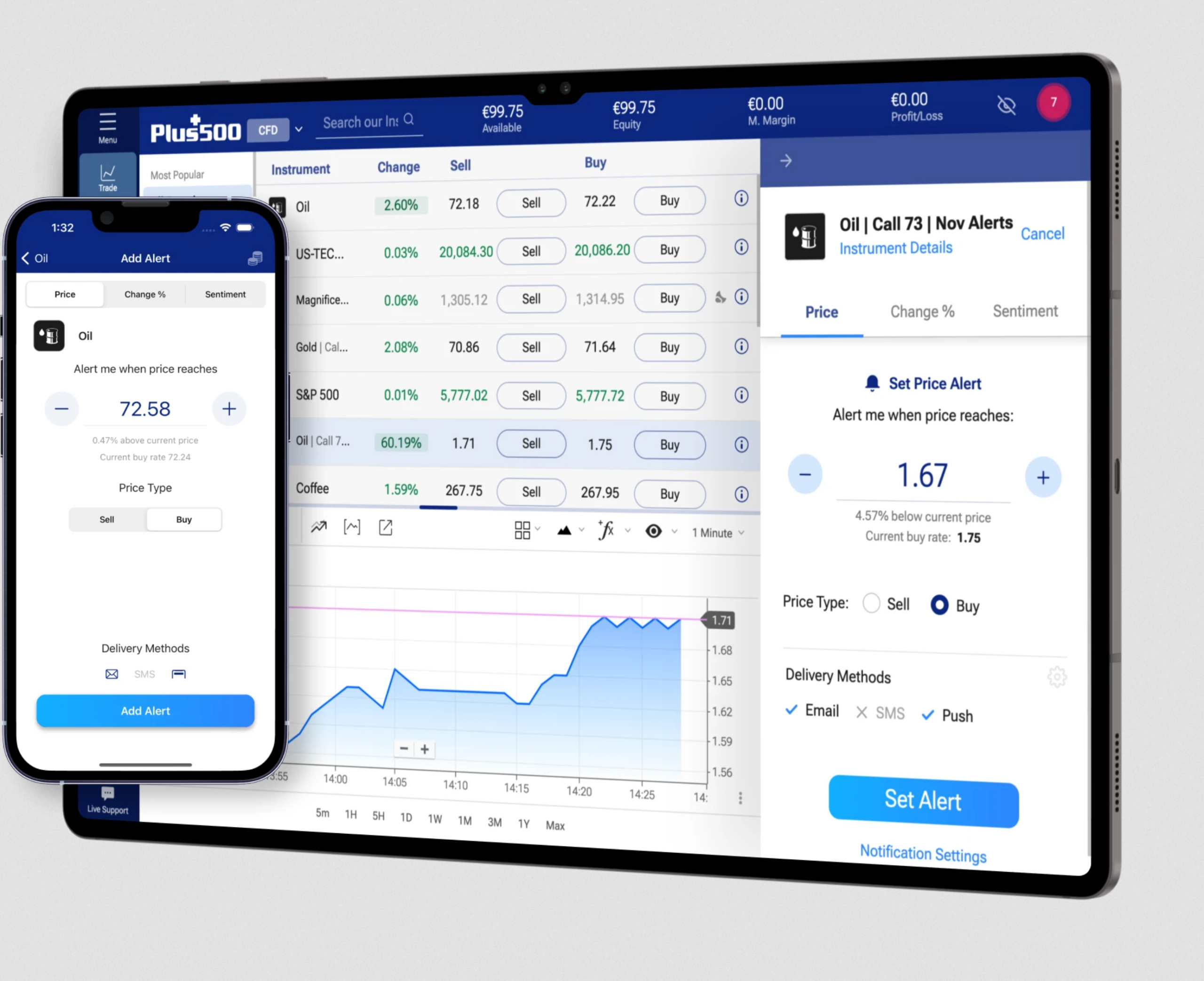
% Change (Daily or Hourly): Receive an Instant Notification of a Percentage Increase or Decrease. Change percent alerts are used to get notifications when the absolute price change (positive or negative) of an instrument exceeds a specified level. Change percentage notifications can also be set to reoccur daily or hourly.
Traders’ Sentiments (Buyers % vs. Sellers %): Discover How Others Are Trading in Real-Time. The Traders’ Sentiments tool is a one-of-a-kind notification tool that is activated automatically when the proportion of Buyers or Sellers (among Plus500 clients) reaches a specified threshold.
AI Bites
+AI Bites gives traders fast, relevant market context at the point of decision. By combining AI-generated news summaries, technical analysis, key levels, platform sentiment, and overall market direction, it helps users understand the current state of an instrument without leaving Plus500. The feature is designed to complement the trading flow rather than overwhelm users with a full research terminal, offering just enough insight to build confidence and support action. Early usage and feedback show strong engagement, with users valuing the clear summaries, sentiment indicators, risk context, and direct link between insight and trading decisions.
Education
Plus500 provides a range of educational resources, including helpful trading videos and articles designed to expand your market knowledge. In addition, the platform features an extensive FAQ section that explains its products, markets, and key trading concepts in a clear and accessible way.
Economic Calendar
The economic calendar, which is driven by Dow Jones data, may be utilised as part of a fundamental study. It keeps you up to speed on the newest market news events and assigns a grade to each event’s potential impact, ranging from low to medium to high. The name of the release, nation, connected instruments, date and time, level of influence, and actual/previous/forecasted result are all displayed. The calendar may also be set to display company events, which is a helpful feature that not many other brokers provide.
Risk Management Tools
These basic but effective trading tools might help you control your risk.
Close at Profit [Stop Limit] and/or Close at Loss [Stop Loss]: When initiating a new position/pending order or amending an existing position, you may add ‘Close at Profit’ [Stop Limit] and ‘Close at Loss’ [Stop Loss] orders to your trades. These orders enable you to specify the rate at which your position will be closed in order to safeguard your profit in the case of a Close at Profit order or to minimise your loss in the event of a Close at Loss order. Please keep in mind that Close at Profit and Close at Loss orders do not ensure that your position will close at the precise price level you specify. If the market price suddenly gaps down or up at a price over your stop level, your trade may be terminated at the next available price, which may be different from the one you specified. This is referred to as slippage.
Guaranteed Stop: Adding a Guaranteed Stop order to your trading position limits your possible loss to zero. Even if the instrument’s price swings drastically against you, your position will be terminated immediately at the stated price, with no chance of Slippage. Guaranteed Stop is only available for a few instruments. If an instrument supports the Guaranteed Stop order, a checkbox will appear on the platform (after you have selected the ‘Close at Loss’ checkbox).
A Guaranteed Stop order may only be applied to a new trading position/pending order, not to an existing position. When the instrument is accessible for trade, a Guaranteed Stop can be activated/edited. Only a Close at Loss order can be altered or deleted after your Guaranteed Stop order is operational. Once activated, the extra spread fee for a Guaranteed Stop is non-refundable and will be indicated prior to acceptance. The Guaranteed Stop level must be a predetermined distance away from the instrument’s current trading price.
Trailing Stop: A Trailing Stop order allows you to lock in a set amount of earnings. When you establish a position or pending order with a Trailing Stop, it will stay open as long as the price goes in your favour, but it will close automatically if the price changes direction by a predetermined number of pips*. When you use a Trailing Stop, you may put a Close at Loss order that automatically updates when the market advances in your favour. If the market moves unfavourably, the Close at Loss order is triggered (in accordance with the requested pips change). This service is free, but there is no assurance that your position will close at the exact Close at Loss level due to ‘Slippage.’

Trader’s Guide
The Plus500 website has an excellent collection of trading instructions. There are ‘how-to’ videos available to help you learn more about online trading with Plus500’s platform. They cover a variety of subjects, including an introduction to CFD trading, trading methods, and more.
News and Market Insights
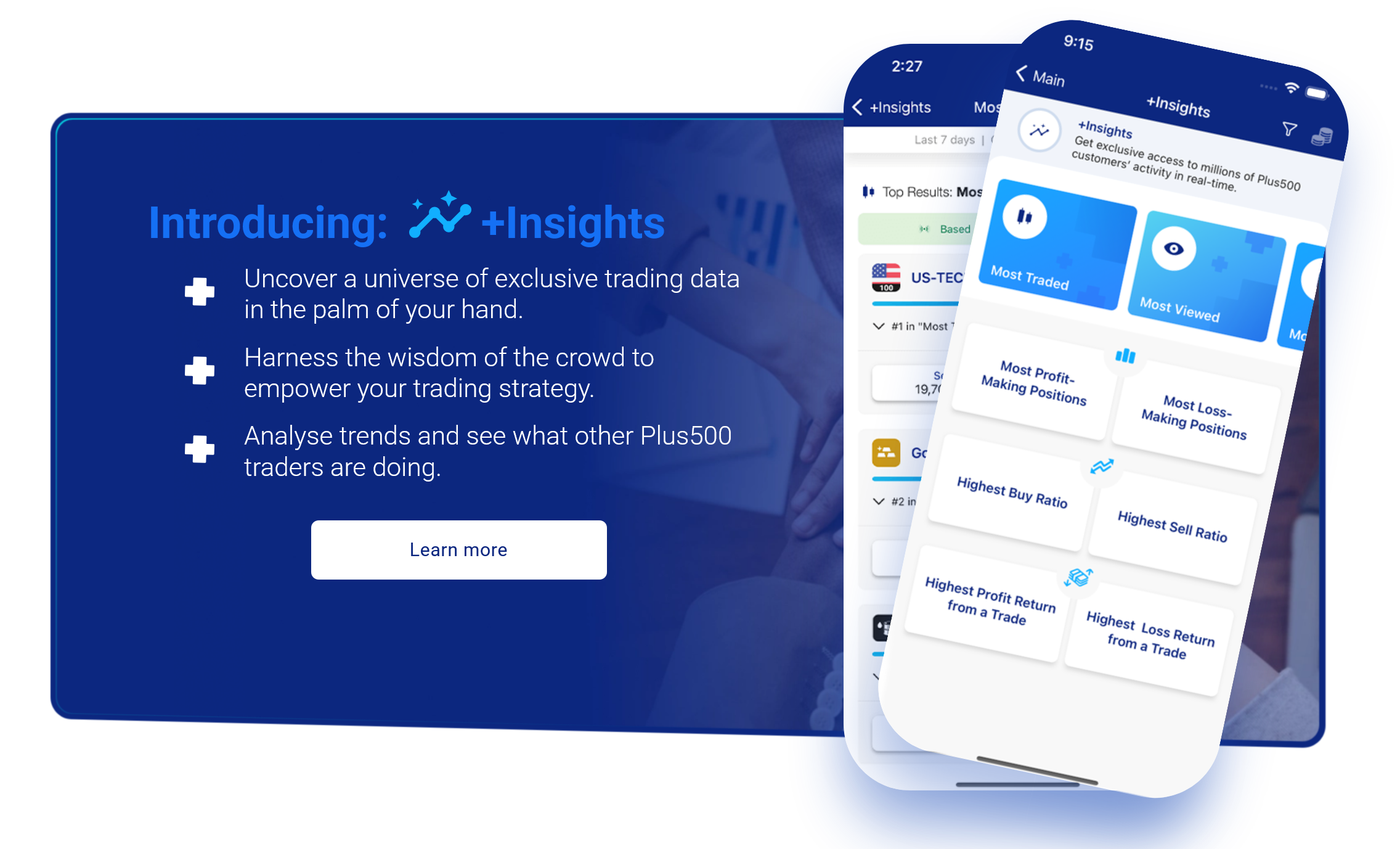
The Plus500 website also has a very informative news and insight section. Here you will discover some fascinating articles that will keep you up to date on the newest market news and its influence on various instruments.
Conclusion
Plus500 stands out as a global, technology-driven trading provider with a long-established presence in the financial markets. Since 2008, the company has built a strong reputation by combining strict multi-jurisdictional regulation with an intuitive proprietary platform and a continually expanding range of instruments. Today, clients can access over 2,800 CFD markets across forex, shares, indices, commodities, ETFs and options — all through a seamless trading experience available on desktop, web and mobile.
For traders in the United States, Plus500 also offers a regulated futures trading service, allowing access to popular U.S. futures products through a dedicated entity — a major advantage for those seeking exchange-traded derivatives rather than CFDs.
Plus500’s fee structure is transparent, spreads are competitive, and the platform includes essential tools such as advanced charting, alerts, risk-management features and a built-in economic calendar. The broker’s clean interface, responsive execution, multilingual support and accessible demo account make it suitable for both beginners and more experienced traders. Its ongoing focus on innovation and global expansion further reinforces its position as a leading trading brand.
Overall, Plus500 delivers a robust, reliable and modern trading environment backed by strong regulation, global reach and a user-friendly platform. Whether you’re exploring CFD markets worldwide or trading futures in the U.S., Plus500 remains an excellent choice for traders who value simplicity, security and broad market access.
Plus500

Pros
- Over 2,800 instruments across major CFD asset classes
- Highly regulated: multiple trusted global regulators
- Proprietary platform that’s intuitive, fast and easy to use
- Commission-free trading (costs built into spreads)
- Good charting tools + alerts + risk-management features
- 24/7 customer support in many regions
- Fast, simple account setup with fully online verification
- Free demo account with unlimited practice
- Mobile apps mirror the web platform for full on-the-go trading
- Transparent fees and no deposit/withdrawal fees (third-party fees may apply)
Cons
- Inactivity fee after long periods with no login
- Instrument availability varies by region (e.g., CFDs not available in U.S.)

I’m a self-confessed Forex geek who spends countless hours researching, testing, and reviewing everything related to trading. With many years of experience in the Forex industry—and thousands of robots, brokers, strategies, and courses put to the test—I’ve seen what works and what doesn’t. My goal is simple: to share that knowledge with you for free, so you can navigate the exciting (and sometimes crazy) world of Forex trading with more confidence.


